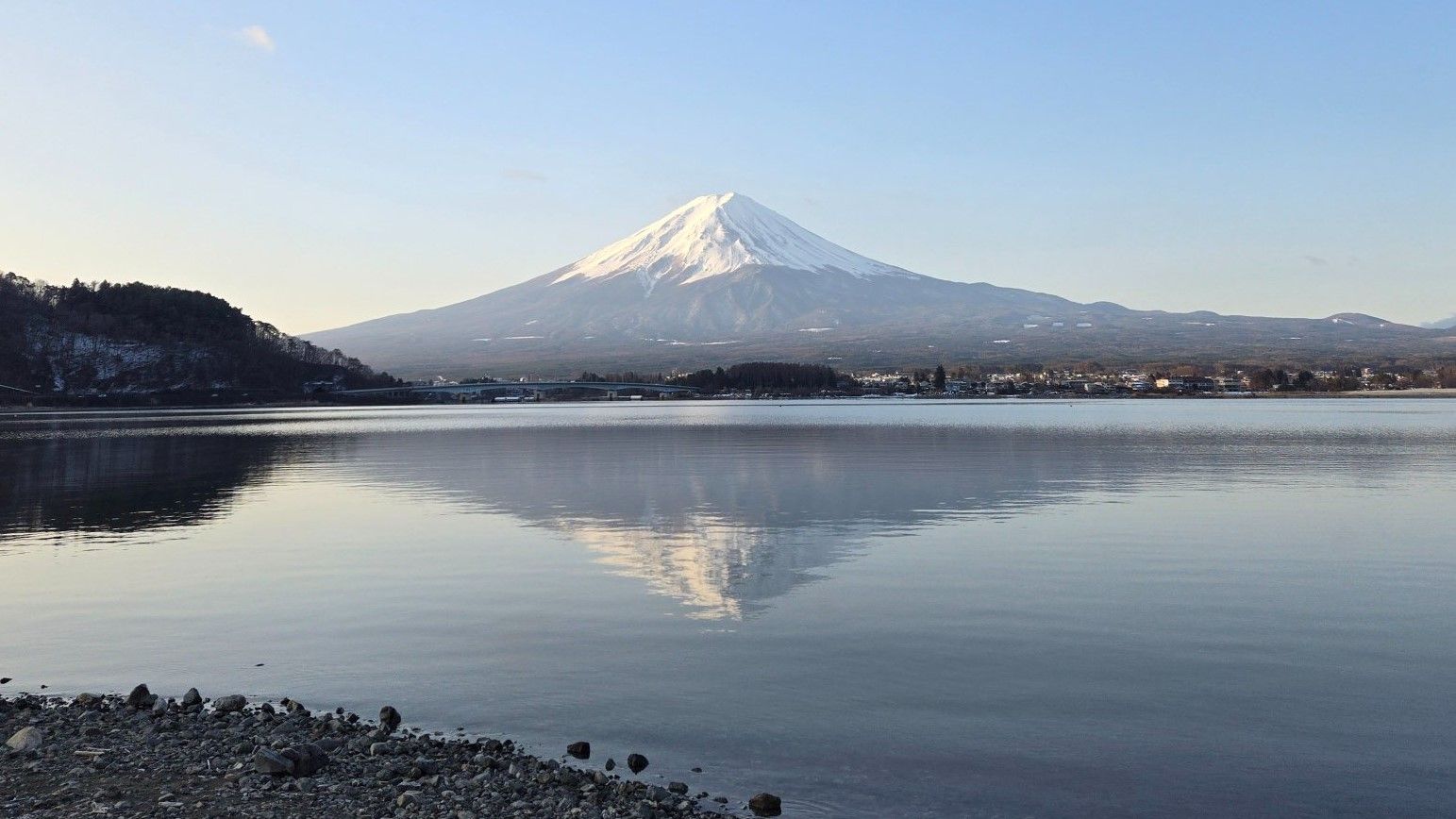
Introduction
It was early March, and after finishing our ski trip in Naeba, my friends and I returned to Tokyo.
At the start of our planning, we realized we didn't have many days left before our flight home. Between city shopping and sightseeing, time was tight.
After discussing with my friends, we decided to split up for a day. They wanted to visit Yokohama to see the Gundam (before it was dismantled at the end of March). Since I had already been to Yokohama last year (3-Day Trip to Yokohama, Kamakura, and Enoshima), I decided to head to Mount Fuji—a place I had always longed to visit but never had the chance to.
This was my first solo trip abroad, and I was a little nervous.
Mount Fuji is arguably the most iconic symbol of Japan. If you're visiting Japan for the first time and want to explore a slightly more distant suburb, I think Mount Fuji is the top choice.

Itinerary Planning
The area around Mount Fuji is quite vast, famously known as the Fuji Five Lakes. This time, I only visited the most famous tourist spot: Kawaguchiko.
I chose to take the highway bus from Shinjuku to Kawaguchiko.
Although I considered the famous Fujikyu Railway, I found the booking process a bit cumbersome and the schedule limited, so I opted for the bus, which has more frequent departures.
I did a lot of research for this trip. As a first-time solo traveler, I was anxious, but everything went according to plan, and I didn't get stranded at the foot of the mountain.
I was quite lucky.
Here is a brief record of my 2-day solo trip. Even though I stayed overnight, it felt like a bit of a whirlwind tour.
If I have the chance to go again, I think I’d spend a few more days, and renting a car would definitely be better.
The attractions around Mount Fuji are scattered and quite far apart.
While there are buses, they require many transfers and are subject to strict schedules.
Compared to Nikko, which I visited previously, I found the transfers here much more complex and time-dependent.
Now, let’s dive into the details of this 2-day trip.
Day 1
Shinjuku Bus Terminal
I arrived back in Ueno from Echigo-Yuzawa around noon. Since I had pre-booked the 14:15 bus online, I immediately transferred to Shinjuku.
Booking the highway bus is quite intuitive. At first, the website looked so simple I thought it might be a scam (oops!).
If you have time, you don't actually need to pay online; you can just pay on-site. You can also buy tickets separately; the price is the same, and it's easier to change your schedule if needed.
I mainly referred to this article, which is very detailed.
Let the pictures tell the story.
Exiting JR Shinjuku Station and heading toward the South Exit leads you to the Shinjuku Expressway Bus Terminal (the JR station was under construction that day, and I almost got lost).

I think the bus terminal design is excellent. The signage is clear, and there is a tourist information center (which supports multiple languages; I asked about lockers there).
The information and signage inside the terminal were much clearer than I expected. I didn't feel lost at all.
The integration of software and hardware is great, which made me appreciate it even more compared to the slightly dated booking website.
There are also many automatic ticket machines on-site with Chinese language options.

When the time came, I showed the driver the QR code from my reservation and successfully boarded the bus to Kawaguchiko.
The journey took about two and a half hours. There were many tourists that day, mostly from Europe and America.

Fujisan Station
Since I arrived in the afternoon on the first day and was leaving the next afternoon, I planned to visit the famous Yoshida Shopping Street, have dinner there, and then head to Kawaguchiko.
So, I got off at Fujisan Station, which is one stop after Kawaguchiko Station.


Kawaguchiko LAWSON.As soon as I got off the bus, the atmosphere felt completely different. I really love the Japanese countryside.
Low-rise houses, clean and quiet streets, paired with the beautiful Mount Fuji—my mood instantly relaxed.

Golden Torii
The first stop was the famous Golden Torii. The massive torii frames the mysterious and beautiful Mount Fuji. Combined with the passing cars and streetscape, it felt sacred, as if it were a boundary.
It’s very photogenic. I lingered here for a long time, and as the sun set, it took on a different feel.


Shimoyoshida Honcho Street
Next, I walked back along the famous Shimoyoshida Honcho Street, finally heading to the intersection near Hikawa Clock Shop to capture the sunset and street view.
The Showa-era style shopping street, directly paired with the view of Mount Fuji in the background, was breathtaking.
It felt a bit lonely here, like a declining shopping street, but perhaps that’s the atmosphere. If it were bustling with traffic, it might have ruined the view.
I couldn't bear to crop any of these photos.


Actually, I think it felt a bit lonely, like a declining shopping street, but perhaps that’s the atmosphere. If it were bustling with traffic, it might have ruined the view.
There were some people at the Honcho 2-chome corner taking photos; it was the busiest part of the street.

Dinner - Oshokujidokoro Izumiya
I hadn't planned dinner in advance, thinking I'd just search on Google as I walked.
However, two places I tried were closed, and it was getting late. It was quite cold in the Fuji area in March, and away from the core of the shopping street, the surroundings were getting dark.
Finally, feeling discouraged, I passed by Oshokujidokoro Izumiya.
It was brightly lit, so I walked in. It seemed to be a local family restaurant, and the customers were all Japanese.

The landlady invited me to sit at the counter. In the kitchen, it seemed like a father and son were working, and the atmosphere was meticulous.
I hadn't eaten much since leaving in the morning, so I was starving. I ordered the pork tenderloin cutlet set + sashimi to treat myself.

Maybe it was the mood, or maybe because I hadn't eaten anything good while skiing in Naeba, this was the best meal of my Japan trip. The pork cutlet was crispy, the sashimi was fresh and sweet, and the rice was chewy. There were locals chatting with the landlady, which warmed my heart after a day of wandering, and I even felt a little homesick (oops).
A small episode on the way to the hotel
After dinner, it was past 7:00 PM. The thing I worried about during planning happened: I didn't know how to get to the hotel.
When planning, I checked Google and Yahoo Transit, but the bus I thought was available suddenly disappeared from the search results, and the trains seemed to have stopped too.
Sure enough, there is basically no public transport here after 6 PM. I checked the map, and Google said it was about a 6km walk, taking an hour and a half. That seemed okay, but I didn't dare to do it, especially since it seemed to be a mountain road, it was pitch black outside, there were no streetlights, and it was very cold.
Scared.jpg

In the end, I had no choice but to walk back to Fujisan Station, thinking there might be taxis there. I was lucky to find a driver waiting at the station. I used my broken Japanese to ask him to take me to Kawaguchiko, as my hotel for the night was on the northeast side of the lake - Hotori no Hotel Ban.

BAN Hotel
After arriving at the hotel, I checked in. The receptionist was a Southeast Asian(?), very kind, and said he was waiting for me as the last guest.
BAN Hotel is divided into two buildings, both two-story bungalows with few rooms. I stayed on the second floor of the other building, and the facilities were quite new. I thought it was great.
There is a FamilyMart under the main building, which is very convenient in the quiet night of Kawaguchiko.

I chose this hotel for a reason. Since it was a 2-day whirlwind trip, I wanted to go to the lakeside the next morning to photograph the inverted Fuji and visit the popular Kawaguchi Asama Shrine Sky Torii.
So I tried to find a hotel near the northeast side of the lake. I thought there wouldn't be as many crowds in the morning (the north side is really expensive... I couldn't afford it).

I booked one night with breakfast. Maybe it was the off-season, or because I was alone, it only cost about 2,800 TWD at the time.
Considering the room quality and location, it was a great deal.
As for the room facilities, see the picture below. I felt it was a bit of a waste for just one person...

It was getting late, so I washed up and went to sleep. I was quite tired after running around all day.
Tomorrow's schedule was packed, mainly because I wouldn't be coming back to the north side of Kawaguchiko after leaving the hotel.
I woke up at 5 AM to walk to the lake to photograph the inverted Fuji, then went to the Sky Torii, and then rushed back to check out. I wondered if I could handle it.
In the end, I made it.

Day 2
Nagasaki Park
I woke up around 4:30 AM, washed up, and set off for the nearby Nagasaki Park to photograph the inverted Fuji.
My mood was very calm, as if I were having a silent conversation with Mount Fuji.
Looking at the photos, I still recall the scenery. Let me post a few more pictures to record the changes and moments.


Around 6 AM, the sun started to rise. Although the reflection of Mount Fuji began to appear on the lake surface.

At this time, some tourists began to gather, about 4 or 5 people, all quietly watching Mount Fuji, hoping to capture the inverted Fuji.


Inverted Fuji
Not super successful, but pretty good, right?
I was lucky; Mount Fuji was very kind that day. The weather was good in the morning with few clouds. It's quite difficult to capture the lake surface completely still.

I stayed here until about 7 AM, when the wind on the lake started to pick up, and then I prepared to leave. This period was truly unforgettable.
Interestingly, the 4 or 5 tourists I mentioned earlier were also Taiwanese 🤣
We chatted a bit. One person was there with their family and also stayed at the BAN hotel (but only he got up early to see the inverted Fuji).

After leaving, I rushed back to the hotel for breakfast because I had to go to the Sky Torii. Although Google said it was a 40-minute walk one way, it was actually quite a distance.
I had to rush back to the hotel to check out before 10:00 AM, which was a bit stressful.
After actually walking it, I was wrong. The whole way was uphill and quite tiring. I should have planned more time. In the end, I even ran part of it 🤧


After eating, I set off immediately.
I have to say, Kawaguchiko in the morning is also very beautiful. It was only then that I clearly saw the beautiful scenery of Kawaguchiko surrounded by mountains.


Kawaguchi Asama Shrine
On the way to the Sky Torii, you will pass by Kawaguchi Asama Shrine.
The shrine is small but antique, and there are prayer and ritual staff.
The giant trees around it are very tall. I prayed briefly and then continued up to the Sky Torii.


Kawaguchi Asama Shrine Sky Torii
Passing through Asama Shrine and walking up for about 20-30 minutes, you will reach the Kawaguchi Asama Shrine Sky Torii, which has become famous in recent years.
I only found out about this spot after watching a video of a Fuji-Kawaguchiko day trip. It suddenly became popular in recent years.
I heard that they originally wanted to build a small shrine here, but the application wasn't approved, so the torii was left there.

The walk up is actually much longer than I imagined, and it's all uphill. Honestly, it's not easy to get to, so be prepared to walk.
You can drive, but I don't really recommend it because there are no parking spaces on the way up, and you can't park on the side of the road. If there are too many people, it's inconvenient.


After walking for a while, I finally reached the top.
I saw the target from afar, the Kawaguchiko Sky Torii. Although I was panting, I was excited.

There is a small box at the entrance asking for a 100 JPY cleaning fee. This is partly private land.
It must have suddenly become popular in recent years, and there are really too many tourists. This place is like a paradise; I hope it doesn't disturb the ecology too much.

Crossing the entrance, what caught my eyes was the wide platform and the large red torii standing in front of Mount Fuji.
I have to say, it's truly amazing. The red torii paired with Mount Fuji, and the view overlooking the entire Kawaguchiko and Kawaguchiko Bridge.
It lives up to its reputation.


Since I arrived around 9 AM, there were only 3 or 4 people there. I was the last one. There weren't many people yet, and everyone was queuing up in order.
It was a good plan, thanks to staying overnight and choosing a hotel closer to the north shore of Kawaguchiko.
The only pity was that the clouds started to get bigger, and the top of Mount Fuji was partially covered, but it was still beautiful, especially with a lonely and beautiful feeling.
Next, I ran down the mountain to catch the 10 AM hotel checkout.

It was almost at the limit, and I only returned to the hotel around 9:45 AM.
Checking out of the Ban hotel is also very simple; just put the key in the box at the door.
Next, I prepared to return to the south side of Kawaguchiko and leave the Kawaguchiko area to go to other attractions.
Although it was a bit rushed, I captured the inverted Fuji and went to the Sky Torii I wanted to visit, so I was satisfied.


Kawaguchiko Lakeside
After leaving the hotel, I walked along the Kawaguchiko lakeside to Ubuyagasaki Shrine near Kawaguchiko Bridge.
Finally, I took a bus to the famous Mount Fuji Ropeway Station and Kawaguchiko Tenjo-Yama Park.

The scenery on the road was beautiful and photogenic. There weren't many people that day, and the whole Kawaguchiko was beautiful and quiet.
The only thing I was worried about was that I still had to walk a lot, and I didn't know if my legs could hold up at night.


Ubuyagasaki Shrine
Walking down to the side of Kawaguchiko Bridge, you will reach Ubuyagasaki Shrine.
It is a very small shrine built on the shore. I saw it because it is also a spot suitable for photographing the inverted Fuji.


Ubuyagasaki Shrine worships Hikohohodemi-no-Mikoto and Toyotama-hime, mainly praying for matchmaking, business prosperity, safe childbirth, and family safety.
I also understood why it is said to be suitable for photographing the inverted Fuji, because the view is unobstructed, with the entire Mount Fuji and Kawaguchiko.

Mount Fuji Ropeway Entrance
Next, I found a bus stop and took the Kawaguchiko loop line to the Mount Fuji Ropeway Entrance station, preparing to take the ropeway to the famous Mount Fuji Tenjo-Yama Park.

Below the ropeway station is a cute cookie shop FUJIYAMA COOKIE.
You can choose your own cookies, and there are gift boxes. The cookies are shaped like Mount Fuji, very exquisite and beautiful. Before leaving, I couldn't help but buy a gift box as a souvenir.

In addition, there are Kawaguchiko Takami stands at the entrance of the cookie shop and later at Tenjo-Yama Park. I checked and found out it was a collaboration with the anime Onsen Musume.
Japan promotes various hot springs through anthropomorphism, and Takami is the Onsen Musume of the Fuji-Kawaguchiko hot spring town. Just a bit of trivia.


Next, I prepared to take the ropeway.
Mount Fuji Ropeway Station

The Mount Fuji Ropeway Station is a famous attraction in Kawaguchiko. After taking the ropeway, you can reach the Kawaguchiko Tenjo-Yama Park above to overlook the panoramic view of Mount Fuji and the city. The crowds started to increase here.
There are also some interesting small facilities above, like a small park on the mountain, just a bit high XDD
Interestingly, you can walk down the park after going up, or take the ropeway back.


The mascots of the ropeway station and Tenjo-Yama Park seem to be a raccoon dog and a rabbit, and their designs can be seen everywhere.
As for the raccoon dog, there are two on the ropeway, carved vividly and very cute 🥰


Kawaguchiko Tenjo-Yama Park
After arriving at Tenjo-Yama Park, I walked through a small path to the highest point, which is an open park.
It was almost noon, and the entire Tenjo-Yama Park faced Mount Fuji and the city on the south shore of Kawaguchiko. The crowds were endless, and there were souvenir shops and tea shops.


If you want to take good photos of Mount Fuji, the wooden boardwalk before reaching the park is also very suitable for stopping and taking photos.
At noon, there were no clouds like in the morning. The weather was clear, and Mount Fuji was wearing a complete lenticular cloud, which was very special.

The entire Tenjo-Yama Shrine seems to focus on matchmaking, love, wisdom, and physical health. The Tenjo-no-Kane and Rabbit Shrine all imply this.
Tenjo-no-Kane

Rabbit Shrine
A small and cute rabbit shrine. The rabbit statues are all very cute, and some have different expressions.


Tanuki Chaya (Raccoon Dog Tea House)
In the middle of the square is the Tanuki Chaya. In addition to buying some souvenirs, they also sell some simple dango and ice cream. Just buy them with the ticket machine.
The tea house logo, signboard, and raccoon dog are all very Japanese and well-designed~

The souvenir charms in the store are also full of Mount Fuji elements.
If you miss it, there are many souvenir shops at the foot of the mountain. Cookie types should also be available at the foot of the mountain or nearby shops in Kawaguchiko. If you buy a lot, you might as well buy them below. There is no tax refund service at the tea house.


Next to the tea house, there is an interesting small game - Throwing Kawarake.
You can stand in front of the torii and throw small plates.
As long as you throw it through the rope knot on the torii (there are two, one is bigger and closer, the other is further and smaller), you can have good luck and your wishes can come true.
It seems that if you hit the smaller knot behind it, it will be even...? Forgot XD, but that is really super difficult.


Walking up from the tea house, there is a small second-floor platform with a good view.
Further up, there is a sky swing. The crowd looked quite happy. Because of time constraints, I had to go to other spots in the afternoon, so I just took some photos and prepared to return.


Kawaguchiko Station
Leaving Tenjo-Yama Park and the ropeway, I walked back to Kawaguchiko Station, which I only passed by on the first day.
Feeling the style of Kawaguchiko and the city streets, I prepared to leave Kawaguchiko and head to the next station, the last stop of this trip, Shimoyoshida Arakura Fuji Sengen Shrine.
There are also many souvenir cookie shops along the way, so you can go buy some if you are interested.
Kawaguchiko Station is also quite complicated, to be honest. Various buses converge, and there are several platforms. Although I took the travel brochure to see it, I was really confused. You really have to do your homework.


Kawaguchiko Lawson
I went back to the station later to take the bus, but first I went to the famous Kawaguchiko Lawson that I passed by on the first day.
There were really a lot of people watching and taking pictures, and there were police directing traffic.
The flat roof of Lawson is really the entire Mount Fuji. Is this the most beautiful convenience store?
However, I didn't expect that after I left, news came out in March that a black curtain would be built here, becoming a legend. But thinking about it, it's good to give the locals some peace. There were really too many people gathered here at that time. If it were the peak tourist season, it would be even more exaggerated.

After returning to the station, I prepared to find a way to Shimoyoshida. I originally wanted to find a bus, but after exploring, I felt that the train could also go there, so I went to the station to buy a ticket.

Fujisan View Express
Unexpectedly, I happened to encounter the famous Fujisan View Express that was parked and ready to depart.
It happened to have unreserved seats and would also go to Shimoyoshida, so I followed the signs, quickly bought a special ticket, and swiped my IC card to experience it briefly.


Arakurayama Sengen Park
After a short while, I arrived at Shimoyoshida Station, preparing to go to the last attraction - Arakurayama Sengen Park.

The park is located on the hillside of Arakurayama and is famous for its cherry blossoms, Mount Fuji, Chureito Pagoda, and Yoshida city scenery.
I saw tourist introductions, and the photos of cherry blossoms in full bloom in spring are truly breathtaking.
After getting off the train, there are signs all the way. Walk 10-15 minutes in the opposite direction of the mountain from the station to arrive. If you drive, there is also a parking lot nearby, which is well planned.
There are also many small stalls on the roadside, and some sell fruit. If you are hungry, you can replenish your strength.


Did you think it was over when you arrived? No, the bottom is just the main shrine. The entire Arakurayama Sengen Park is really a huge park as its name suggests.
You have to go all the way up to see the whole view. You can go straight up the stairs, or you can go hiking and climbing up and down, which is very suitable for wasting physical strength (oops).

Sakuya-hime Stairs (Stairs of the Blooming Goddess) 398 steps!!!
Chureito Pagoda
The first thing you see when you go up is the Chureito Pagoda. The pagoda is used to comfort the souls of the war dead. The entire building is well maintained and has a solemn atmosphere.
Further up, the park has built several platforms for tourists to enjoy the scenery.

Standing on the viewing platform, you can see the most famous scene of the park.
Mount Fuji, Chureito Pagoda, Yoshida city area, cherry blossoms (not in season this time, so no XDD), the beauty of the integration of architecture and scenery.


There are many people on the viewing platform because there are places to sit and rest there. In addition, there are several big cannons (cameras) occupying the space. If you want to take pictures, you have to adjust.
After taking some photos, I walked around the park. This area is actually quite large. Further up, there seems to be a lavender garden and some shrine worship places, but I didn't walk up any further and prepared to go down the mountain.

Arakurayama Sengen Shrine
When you reach the bottom, you will encounter Arakurayama Sengen Shrine. I prayed briefly.
The shrine is not big, but the atmosphere is quite serious. On the left is an office that provides amulets and prayer items.
I asked the shrine staff to write a Goshuin here as a souvenir. Also, I was hit by the Goshuin book here, so I bought my first Goshuin book in my life, leaving a perfect ending!


Shimoyoshida Station
Next, I walked back to the station and looked for something to eat. It was almost 3 PM, and I was starving.
I only had hotel breakfast since the morning, and I walked so much that I saw stars.

I originally wanted to eat at a convenience store, but the nearest one I went to didn't have indoor seating. This area is really quiet and lonely except for the station.
In the end, I thought I still had to sit down, my legs were almost failing, so I went to Arakura Shokudo, which was still open in front of the station, to have a meal and rest, waiting for the 16:30 bus.
Arakura Shokudo is simple, just like a family restaurant.
There is a tatami area and a regular table area on the first floor. It seems that the second floor is an Airbnb-style guest room hotel. I saw some promotions.
Interestingly, I also saw some introductions promoting the healthy curry here. The hostess is a nutritionist and has been on TV. It seems she has done special research.

Chuo-do Shimoyoshida
After a full meal and a rest, I prepared to return to Shinjuku.
Like the departure, I took the highway bus back and pre-booked the 16:24 bus on the bus website.
The boarding point is at Chuo-do Shimoyoshida, which is a bit far from Shimoyoshida Station, so you have to walk a little.

Unexpectedly, the station is not like a traditional station, but directly on the side of the highway (Chuo-do is the Central Expressway).
There was only a small pavilion at the time, and I waited for the bus there.
During this period, a group of Taiwanese and a group of French people came one after another, all returning. We chatted a little. It's good to have someone on the deserted highway XDD

Shinjuku Expressway Bus Terminal
After some twists and turns, I successfully returned to the colorful Tokyo, and then went to Shibuya to meet my friends.
It feels like a lifetime ago.
This 2-day trip has come to an end.

Conclusion
Well, I finally fulfilled my wish to visit Mount Fuji.
A 2-day solo whirlwind trip, with twists and turns, fear, and surprises.
Yamanashi Prefecture is really a good place, with fresh air and beautiful scenery, and Mount Fuji is Mount Fuji.
It’s just beautiful and photogenic.
Although I was very tired from walking, it was great that I planned this trip and it ended smoothly. If I have the chance next time, I want to come back for a few more days. Renting a car would be nice, or camping here would be great.