See the previous Oku-Nikko travelogue here: [Travelogue] Oku-Nikko: Lake Yunoko and Senjogahara Nature Tour
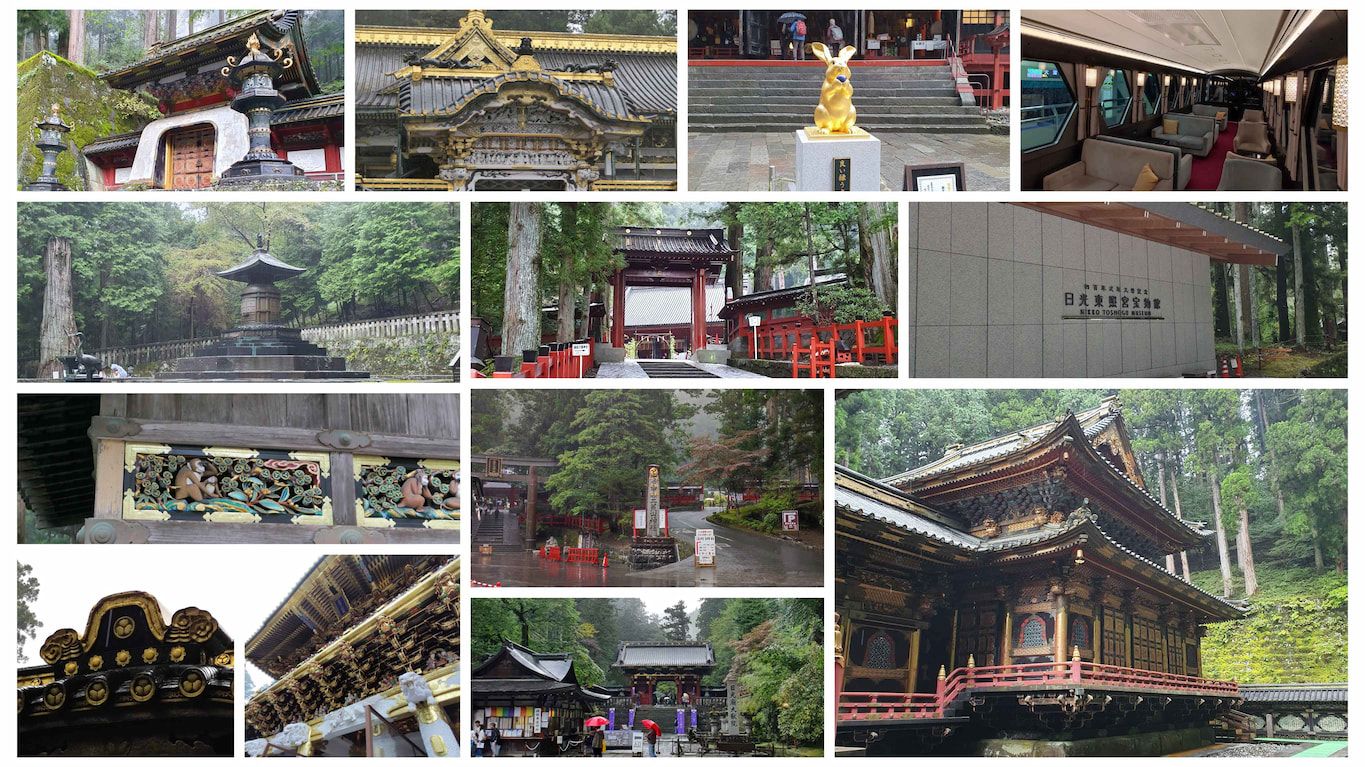
This post covers my final day in Nikko. After leaving the unforgettable Hotel Kojoen in the morning, I took a bus down to the famous Two Shrines and One Temple to see the World Heritage sites and the renowned Nikko Toshogu Shrine, before catching the Spacia X back to Tokyo in the evening.
Writing this now, the memories come flooding back. Nikko really is a wonderful place.
The only downside was the rain on this last day, which forced us to wander through the shrines and temples in the downpour and slightly impacted our itinerary. However, it was a blessing that it didn't rain during our hikes around Lake Chuzenji and Lake Yunoko for the first two days—hiking in the rain would have been much worse! 😅
As always, let me record this World Heritage journey.
Lake Chuzenji in the Rain
Waking up to the sound of light rain, I knew it was going to be a wet day. Opening the window at Kojoen, the entire Lake Chuzenji was draped in a rainy hue.


Breakfast at Kojoen was excellent as always, but the rain gave the already quiet Lake Chuzenji an even more lonely, melancholic atmosphere.
As we prepared to leave, I felt a touch of sadness, but we are only travelers, after all—we leave with our memories~


After packing up and settling the bill, we were ready to leave Kojoen.

We didn't bring umbrellas, so we went to a nearby souvenir shop to buy raincoats or umbrellas. Since it was early, most shops weren't open yet, and we had to visit several before finding any.
I chose a raincoat, but the size was too small, so I still got quite wet while touring the shrines and temples (thankfully, my backpack was waterproof XD).
We boarded from Chuzenji Onsen Bus Terminal, but this time heading back down to Nikko.


We continued our descent past Akechidaira and the Irohazaka Winding Road. Although there were many curves, the Nikko bus drivers are very steady.
Also, the buses here are quite punctual, so you can plan your time accordingly.
Finally, we got off at Nishisando Entrance, ready to head to the famous World Heritage site—the Two Shrines and One Temple.

Two Shrines and One Temple
To start, the "Two Shrines and One Temple" refers to the famous Futarasan Shrine, Rinno-ji Temple, and Nikko Toshogu Shrine.
After walking through them, I deeply felt the richness of the history and religious culture here, and the architecture is truly unique.
The historical ruins, shrines, and temples are so numerous that it's dizzying, and each has its own distinct character. If you really want to understand every location in depth, setting aside more than a full day is definitely worth it.
(Some areas have quite a lot of walking, so be careful not to get lost, and there are many stairs—it gets a bit tiring XD)
After entering from Nishisando, the first thing that caught our eyes was Futarasan Shrine.

Futarasan Shrine
I actually saw Futarasan Shrine at Lake Chuzenji as well. Like many Japanese shrines, it is divided into Hongu (Main Shrine), Okumiya (Inner Shrine), and Chugushi (Middle Shrine).
The one located in Nikko is the Hongu Shrine, which was rebuilt.
The Okumiya of Futarasan Shrine is on Mount Nantai. I heard it requires a certain level of mountaineering skill, and there is relatively little information about it online; it's said to be quite challenging.


Unlike Toshogu or Rinno-ji, which are dedicated to the Tokugawa family, Futarasan is dedicated to the deity of Mount Futarasan.
The entire shrine remains relatively traditional and simple, without overly ornate decorations.
Futarasan Shrine is actually very large. Walking further in, there is the famous Futarasan Reisen (Sacred Spring) and other auxiliary shrines. I remember walking for quite a distance and still finding small shrines or statues.
According to Wikipedia, the total area of Futarasan Shrine is 3,400 hectares, second only to Meiji Jingu among all shrines in Japan, which gives it a more serene atmosphere.

After praying for peace and good fortune, we continued to wander around Futarasan Shrine. There are truly many small spots here; personally, I feel it's mainly focused on praying for good relationships.


Futarasan Reisen (Sacred Spring)
There is also the famous Futarasan Reisen here, formed by sacred water naturally springing up around the shrine.
It consists of the Water of Wisdom, Spring of Sake, and Water of Youth, primarily prayed to for increasing wisdom, good fortune, and maintaining youth and health.
Three small signs stand in the pool, which is inexplicably cute.


My simple impression of Futarasan Shrine is that it's dizzying—there are just too many small spots XD.
Interestingly, some of the prayer spots here even support PayPay for donations. Thinking about it, that's actually quite good; otherwise, with so many shrines, it's easy to run out of coins, and collecting them is inconvenient (and they might rust).
Sometimes it's the thought that counts, and I think it's fine not to be restricted by form.
PayPay is indeed the leader in cross-border electronic payments in Japan now, and with Taiwan's JKO Pay, E.Sun Bank, and PX Pay gradually supporting it, I have to say they are very good at capturing the market.

After leaving Futarasan Shrine, we set off for one of the sites of Rinno-ji Temple, the golden and magnificent Taiyuin.
Rinno-ji Temple is actually quite scattered; it is a collective term for the various halls, pagodas, and temples throughout Nikko. Besides Taiyuin here, other famous ones include the Sanbutsudo (Three Buddha Hall) and the Treasure House (which we visited last).
Nikko-san Rinno-ji Taiyuin
Before coming to Nikko, I didn't have a deep understanding of Tokugawa Ieyasu, who is worshipped here. Although I knew a little history from watching anime or playing Dynasty Warriors as a kid, I didn't focus much on Japan's Sengoku period (you played Dynasty Warriors, not Samurai Warriors).
The temples here have design stories related to the figures they worship, and this trip helped fill in a lot of knowledge. Knowledge++
Rinno-ji Temple is the mausoleum of the third Tokugawa Shogun, Tokugawa Iemitsu; Taiyuin is his posthumous name.
Legend has it thatTokugawa Iemitsudeeply revered his grandfather,Tokugawa Ieyasu, and declared before his death that he wished to serve him. Therefore, his descendants built this Taiyuin according to his will.

The most interesting thing I found in history is that although the Taiyuin temple layout is similar to Toshogu, with golden and magnificent decorations,
the construction design deliberately kept its level of splendor below that of Toshogu, adding a touch of elegant black to show reverence for Toshogu (Tokugawa Ieyasu).
Nitenmon Gate
After passing the Niomon Gate and walking a short distance, you will see the famous Nitenmon Gate of Taiyuin.
The colors of the carvings on the eaves of the Nitenmon Gate are gorgeous (gold, black, vermilion, and even overlapping blue and green), which is quite exquisite.


The Nitenmon Gate is guarded by two Japanese deities, Jikokuten and Zochoten, hence the name Nitenmon (Two Heavenly Kings Gate).
In addition, there are statues of the Wind God and Thunder God in another corner of the gate. At the Two Shrines and One Temple, you can pay special attention to the gates of these temples; many of them enshrine statues.


Yashamon Gate
Before officially reaching the main hall of Taiyuin, you will pass through the Yashamon Gate.
The Yashamon Gate is named after the 4 different Yaksha statues located on this gate.
Like the Nitenmon Gate we passed earlier, the Yashamon Gate is decorated with a mix of splendor and stability, though the Yashamon Gate is relatively more vivid and brilliant than the Nitenmon Gate.


Taiyuin Karamon Gate
Continuing forward, you will reach the core entrance of Taiyuin, the Karamon Gate, and further ahead are the corresponding Main Hall and Prayer Hall.


Prayer Hall, Main Hall
Walking into the depths, the Prayer Hall and Main Hall are the most golden and magnificent parts of the entire Taiyuin, and also one of Japan's famous national treasures.
The whole place is really shimmering with gold (though it's even more dazzling at Toshogu, because it's a white and gold combination; this place is more black, gold, and red).
If it hadn't been raining and the sun had been shining that day, it would have been even more dazzling.


Taiyuin Mausoleum Kokamon Gate
Walking forward is the Kokamon Gate, the deepest part of Taiyuin open to the public. Beyond this, it is not open to the public, as it is the mausoleum of Tokugawa Iemitsu.
The Kokamon Gate is especially unique. In addition to the existing eave and beam designs of the Nitenmon and Yashamon gates, the waist wall in the middle is designed in white.
The contrast is very special and familiar, feeling more like ancient Chinese or Korean architecture.

Touring up to here, we were ready to return and head to other parts of Nikko. I feel like we didn't even cover 1/3 of the spots in the Two Shrines and One Temple.
Another thing I think is worth noting is the family crest of the Tokugawa family.
You can see the Tokugawa family crest, called Mitsuba Aoi (Three-leaf Hollyhock), widely designed on various buildings, embellishing them without losing design, complementing each other perfectly.

Nikko Toshogu Shrine
The heavy rain delayed us a bit, so my friend and I seized the time to head to the highlight of the day, Toshogu.
Toshogu is the place where the first Shogun of the Edo Shogunate, Tokugawa Ieyasu, is worshipped. It is said to be the most golden and magnificent place within the Two Shrines and One Temple.
On the way to Toshogu, I clearly felt that there were many more people.


Shinkyusha (Sacred Stable)
After entering, on the left is the very famous Shinkyusha and the Three Wise Monkeys.
It is meant to be a place for the sacred horses to rest, and the lifelike monkey carvings are said to be a symbol that can protect the safety of the horses.

The monkey reliefs on the Shinkyusha actually metaphorically represent a person's life. If you look closely, you can see them from birth to growing up and entering the world.
It's quite interesting. At first, I didn't think of it, just felt the carvings were beautiful, but later I learned about this meaning after reading the introduction.
Three Wise Monkeys
Among the monkey carvings, the most famous are the Three Wise Monkeys (Sanzaru), representing "See no evil, hear no evil, speak no evil."
Corresponding to the entire carving of a life, it is the youth period, where one needs self-discipline when the mind is not yet settled.

Yomeimon Gate
Walking forward, you will come to the Yomeimon Gate, a national treasure of Japan, golden and magnificent.

Although it was raining that day, I could still feel its magnificence and splendor. The related carvings are also very detailed—architecture, animals, people, decorations, and colors are colorful.
It is said that if the weather is good and the sun is bright, you will be blinded, and the camera will directly overexpose. I wonder if that's true 🤣


Karamon Gate
Continuing forward, you will come to the Karamon Gate, which is also very famous and protects the Go-honsha (Main Hall).
The Karamon Gate is slightly smaller than the Yomeimon Gate in front, but the proportion of white and gold seems to be higher. The two sides of the gate are also changed from white to dragon reliefs. There are too many details!

I remember I couldn't take photos inside. Inside is the Main Hall. I bought a Yomei Incense Amulet here that looked very special.
I remember there were many colors, and I finally chose the white one. The back of the Yomei Incense Amulet is the pattern of the Yomeimon Gate.
It also comes with a box, printed with the Tokugawa family crest and Toshogu decorations, which is very exquisite.

After passing through the Karamon Gate and leaving the Main Hall, we were ready to head to the deeper part above, the final resting place of Tokugawa Ieyasu, Okumiya.
Nemurineko (Sleeping Cat)
Before heading to Okumiya, you will pass the Sleeping Cat, which is also very famous. There is a thoughtful sign asking you to look up, otherwise, you might really ignore it.

Sleeping Cat, as the name suggests, is a cat fast asleep. Actually, behind the sleeping cat, on the other side of the gate, there are sparrows.
Cats and sparrows are natural enemies, but the cat can sleep peacefully, implying world peace.
It's a pity that I walked too fast at the time. When I flipped through the photos, I remembered that I forgot to record it.


Okusha Approach
Okumiya is the innermost shrine, so you will pass a section of stairs and slopes that is not short.
The trees on the side are very tall, and as you get higher, you can overlook the entire Toshogu from above.

Okumiya
After arriving at Okumiya, the whole place is much more solemn, the proportion of black has increased, and there is an extra sense of dignity. First, looking up, you will see the torii gate.
Unlike the red or bronze torii gates in front, this torii gate is mainly black, decorated with gold, and has the Tokugawa family crest, and there are diamond-shaped grid patterns on it. I think it looks very good.


Karamon Gate (Chubumon Gate)
Walking back is the Karamon Gate (Chubumon Gate) in front of the Okusha Treasure Pagoda.
The gate is guarded by two Komainu (guardian dogs), full of solemnity, and tourists can worship from the path surrounding it.

Okumiya Treasure Pagoda
The Treasure Pagoda is the mausoleum of the first Shogun, Tokugawa Ieyasu. It is said to be made entirely of copper.
The whole thing is very solemn, and there is a crane (?) in front, which makes it even more dignified.

Okumiya is not very big. From here, we turned back along the way, ready to leave Toshogu.
Next is the end of this journey, because we have to catch the Spacia X in the evening.
Finally, we arranged to visit the Treasure House, which is said to be very impressive, and some Rinno-ji temples passed on the way back, and then we were ready to go to Shimo-imaichi to catch the train.
Nikko Toshogu Treasure House
The Treasure House is a bit like the National Palace Museum in Taiwan, mainly displaying some ritual vessels or relics of the Shogun family and Toshogu.
You can't take photos inside the Treasure House, so I can only rely on my memory here.
It is worth mentioning that when buying tickets that day, I saw a huge sign - Five Famous Swords of Toshogu, which seems to be a limited-time exhibition.
Although some are replicas, I can only say that swords, especially precious swords, are cool...
Thinking back, besides the sword itself, the scabbard is even more unique.


Inside, besides the treasure display and the history of the Tokugawa family, there are also a small number of souvenirs for sale, which are more designed around the Tokugawa family.
I also remember that there was a portable shrine on display, a portable shrine almost entirely decorated in gold, which looked extremely gorgeous.
I personally recommend visiting the Treasure House; various historical artifacts are quite interesting. Next, we were ready to leave Toshogu.

Rinno-ji Sanbutsudo (Three Buddha Hall)
Next, we returned and prepared to take the bus, passing many halls and pagodas of Rinno-ji Temple.
Since there was still some time, we went to visit the famous Sanbutsudo. Sanbutsudo is the largest temple and wooden building in Rinno-ji.
You can't take photos inside either. In my memory, there are quite a lot of Buddha statues enshrined inside, a super large number.
The architecture is more like a traditional Japanese temple, mainly in red.


Next, we went to the bus stop, took the bus to Tobu-Nikko, and then transferred to Shimo-imaichi to take the Spacia X.
The pity of the entire Two Shrines and One Temple is that the rain delayed us, and in the end, we didn't have time to see the famous red bridge in front of the Two Shrines and One Temple. We also got quite wet along the way, and couldn't take out the camera borrowed from friend M to take pictures, so we had to rely on the mobile phone.
However, the blessing in disguise is that the backpack and mobile phone are waterproof. It was worth buying a slightly higher-end backpack at the time.
Shimo-imaichi Station
Arriving at Shimo-imaichi Station, we prepared to take the 17:05 Spacia X back to Asakusa. This time we booked the rare Cockpit Lounge class, which we were especially looking forward to 🤣
However, we hadn't eaten anything after touring the Two Shrines and One Temple all day, and my friend and I were super hungry. We simply went to a supermarket in Shimo-imaichi to buy some cooked food to eat. It's quite rural here, and there aren't as many people as in Nikko, a bit lonely.
Shimo-imaichi Station is a stop on the Tobu-Nikko Line and Kinugawa Line. If you want to go to Kinugawa, you actually have to transfer here. This is the starting point, not through Tobu or JR Nikko Station.
Although it feels like a small station, it is very beautiful and clean. Because it is the starting point for Kinugawa, the SL Taiju Steam Locomotive promoted by Kinugawa also starts from here. Besides some introductions in the station, the overall atmosphere is retro and smoky black.


Spacia X Cockpit Lounge
Finally, it's the highlight of the return trip. We booked the Spacia X Cockpit Lounge.
This class is considered the most popular, because there is only one (that is, near the front cockpit, and the ticket price is only 100 JPY more than the ordinary class, which is very cost-effective, but you have to grab it specially).

The entire cockpit lounge design is semi-open. In addition to the GOEN CAFÉ (on-board cafe) on Spacia X and here, you can also directly see the cockpit.
Since it is the first carriage, if you want to order some snacks from the cafe, you are the first priority (other classes are called by number in turn).


The disadvantage is that people coming and going are usually noisier, and because the chairs are open, it's not very easy to sleep.
The most special thing is that I don't know if it's because it has just been in operation for a short time, but the Spacia X conductor will come to help everyone take pictures XD.

Conclusion of the Nikko Trip
I wrote three articles about the entire Nikko tour. Although it was a pity that it rained on the last day and I didn't see the most golden and magnificent Two Shrines and One Temple, this Nikko trip can be said to be the most unexpected and richest journey.
The modern and gorgeous Spacia X, the magnificent historical sites of Nikko, the sparkling Lake Chuzenji, the natural and primitive scenery of Oku-Nikko and Senjogahara, and the hospitable Hotel Kojoen—all are full of memories when organizing photos.
Before this trip, I didn't know there was Nikko in the suburbs of Tokyo. I only knew about it after a friend's introduction.
I originally thought it was just a rich World Heritage site. After flipping through the data, I found that there are actually super many scenic spots in Nikko. I personally think it is not inferior to other famous suburbs of Tokyo such as Mount Fuji or Kamakura. Those who like historical artifacts should especially like it here.
I also took a lot of photos along the way, mixing mobile phones and cameras. Special thanks to a certain MeteorV for lending me the Fuji X-T4 to experience the fun of taking pictures with a single-lens reflex camera. As a novice, trying it directly, the detail is really much different from the mobile phone, that physical optics... also added a lot of fun to this Nikko trip.
In short, this Nikko trip ends here. I feel that if there is a chance next time, I can definitely come again in autumn, or go to Kinugawa, or take a self-driving tour~
See you in the next article.
Nikko-related travelogues
[Travelogue] Tokyo Suburbs: Nikko, Tochigi Prefecture, Lake Chuzenji
[Travelogue] Oku-Nikko: Lake Yunoko and Senjogahara Nature Tour
[Travelogue] Nikko's Two Shrines and One Temple: A Rainy World Heritage Tour
[Travelogue] Lake Chuzenji Hotel Kojoen 3-Day 2-Night Stay: Beautiful Lake Views and Warm Hospitality