This post is a travelogue of my mid-January ski trip to Zao, Yamagata, focusing primarily on my experiences at the ski resort.
Overall, I think Zao is fantastic. The snow conditions were excellent, and I believe skiers of all levels—beginners, intermediates, and experts—can find something to enjoy here.
The terrain is vast, complex, and full of variety. It has its quirks, but those who love exploration will find it very satisfying.
Warning: This is a long read.
The Beginning
Ever since my first trip abroad to Naeba last February, I felt that skiing just once a year was simply not enough, and I didn't want to keep going to the local indoor slope (Little Ding-Dong) like before.
I've been spoiled by skiing abroad.
As if trying to seize the moment, I wondered: while I still have the stamina and the passion hasn't faded, why not try skiing twice a year? 💸
So, around September or October last year, I started planning my 2025 ski season. This time, unlike last year's semi-guided group, I went fully independent.
My initial plan was:
Mid-January: Budget trip + Red-eye flight. Ski and come back. I targeted theTohokuregion, which I hadn't visited before, and choseZao, hoping to catch a glimpse of the famous snow monsters (Juhyo).Late February: Standard trip. I invited a few colleagues interested in trying skiing to join me in Hokkaido. I hadn't been to Hokkaido either, so it was the perfect excuse (heh).
However, I really didn't want to ski alone. Around August or September, I started asking friends if they were interested. But since this trip was quite hardcore and focused purely on skiing without much sightseeing, it didn't pan out initially.
Then, in mid-November, while I was struggling to book a weekend slot at the local indoor slope (to let my colleagues going to Hokkaido in February get a feel for it), I couldn't get a spot for weeks. I posted on IG about how competitive it was.
Unexpectedly, my college classmate @Gino, whom I hadn't talked to in a while, reached out. We chatted about the indoor slope, and I mentioned my original plan to go to Zao in January. He checked his schedule, found it worked, and was interested. Just like that, the group was formed! XD
It’s funny how things work out.
Itinerary Planning

This trip was quite simple—a quick ski getaway, with skiing as the main focus.
- Tuesday red-eye flight, returning Monday. Three days of skiing, with a bit of wandering around Tokyo at the end.
- I originally considered visiting
Ginzan Onsen, but decided it was too rushed, so I left it for another time.
Although this was intended as a budget ski trip, it still ended up costing about 50,000–60,000 TWD. XD
Besides the fact that skiing is always a money burner 💸, I booked the flights and accommodation a bit too late, leaving fewer options (though the place we stayed was quite good).
Transportation
Since the decision was made in late November, it was quite late, so I rushed to book flights.
Ideally, for Zao, you'd fly in and out of Sendai, Tohoku.
However, the flight times to Sendai weren't great, and being late, they were quite expensive. So, I decided to fly into Tokyo, which has more frequent flights, and take the Shinkansen.
Overall, this was cheaper and easier to manage. Luckily, the price to Tokyo was still acceptable even with the late booking.
Instructor
My friend and I decided to hire a Chinese-speaking instructor for one day to help correct our posture and act as a guide for the resort.
Gino and I can both handle green runs with S-turns.
My issue was that my S-turns felt a bit shaky, especially my body posture—particularly during the heel-to-toe transition. Whenever the slope got steeper, I’d get nervous, lose my flow, and start skidding.
We ended up booking Snowtani Ski School.
We hired a full-day instructor for four hours, costing 15,000 TWD. They specialize in Zao and have expanded slightly to Hoshino Resorts Nekoma. We were lucky to be taught by the founder, Mr. Kotani himself.
It’s rare to find a CASI Level 3 instructor (though he jokingly said 2.85 XD). Meeting a Level 3 instructor is truly... not easy. During the lessons, I could really feel his understanding and passion for skiing.
We learned that their ski school was only established two years ago and is still in the development stage.
Compared to the popular Yuzawa area, Mr. Kotani said he chose Zao because he loves Yamagata and Zao, and the snow conditions are excellent.
Accommodation: Zao Astoria Hotel
Unlike large resort groups, Zao is a hot spring village made up of local inns and hotels, centered around Uwanodai and Zao Onsen Street. It’s famously hard to book.
Since I booked quite late, there were many hurdles.
We eventually chose Zao Astoria Hotel, and the overall experience was excellent. Highly recommended!

Why did we choose Astoria?
When I was booking in early December, it was already very late, and we needed to stay for four consecutive nights.
Most of the highly recommended hotels were fully booked, and the remaining ones were costing 6,000–8,000 TWD per night per person.
Gino and I considered staying in Yamagata City and commuting daily, which some people do.
But thinking about the hassle of catching buses, we wanted to see if we could find a ski-in/ski-out option in Zao.
So, I started checking the official websites of hotels in Zao one by one to see if there was any availability.
Like hunting for a bargain.
It was tough. There were some local options, but Zao is relatively traditional, and many of these Japanese-style inns mostly cater to locals or require direct phone bookings.
Then, I found availability on the Zao Astoria Hotel official website.
Although the hotel is a bit far from the main Uwanodai and Zao Onsen Street (on the right side of the resort), it’s right next to Lift 26. You can ski down directly to the main Lift 2, making it perfect for enjoying the right side of the mountain. Plus, it has its own ski area right at the doorstep—the location is superb.

The price was about 4,500 TWD per night per person, including breakfast and dinner for four nights. That seemed very reasonable.
Finding food in Zao at night outside the Onsen Street is a hassle, and the nightlife is limited. As a skier, eating at the hotel is the most convenient option, and old-school Japanese inns rarely disappoint.
Surprisingly, the hotel also provides equipment rental (with discounts for guests) and a shuttle bus to and from the Zao Bus Terminal. They can even drop you off at Zao Onsen Street or other attractions if you aren't skiing. They were very thoughtful, which solved all our transportation issues.
A small hiccup: the official website didn't accept bookings from foreigners, so we booked through Jalan instead. The price was the same, but we had to pay by credit card upfront.
Astoria is a three-story Japanese-style building. It shows its age, but it’s clean and tidy.
The property is quite large and brands itself as ski x music x seminar?
- Ski: Besides equipment rental, the slope next to Lift 26 is the
Astoria Ski Area, which seems to be managed by them. The lift staff were the same people we saw at the hotel. I personally think this slope is great for practice and enjoying the first tracks of powder. - Music: There is a
Forest Libraryon the second floor, which is quite unique—it has tents, camping chairs, and a piano. - Seminar: They have meeting spaces, and the restaurant area can also be converted.
Room
The room felt a bit dated, but it was clean and spacious, with a small private bathroom. The heating was very warm.
A nice touch was that they replenished tea bags daily and provided Zao souvenir cookies, which were delicious. XD


Hot Spring
Skiing and hot springs go hand in hand.
There are two hot springs: the Large Bath on the second floor of the hotel and the independent Open-Air Bath near the slope.
- The Large Bath has a milder scent and is more spacious.
- The Open-Air Bath is smaller, with indoor and outdoor sections. There are only two shower stations, so you might have to queue if it's busy.

Equipment Rental
Equipment rental is in the basement of the main building. There didn't seem to be fixed hours; we went at 6-7 PM on the first day and someone was there. We were told if no one is around, we can call them.
Just fill out the form and hand it to them. Guests get a discount, and the price was quite good.

I rented a snowboard for three days for 9,500 JPY. They give you a ticket, and you return it on the last day. There’s no strict return time, basically just before the evening (though the resort usually closes at 4:30 PM, so you wouldn't keep it late unless you were going to Uwanodai for night skiing).
If you need to swap or adjust anything, just let them know. I swapped my board for a shorter one on the last day.
For storage, just hand them your board after skiing, and they’ll give you a numbered plastic tag to pick it up the next day. You can keep other gear in the lockers provided, or take it to your room (except for the board).
Note: The rental staff are mostly elderly and don't speak much English, so use a translation app if you don't speak Japanese.
Dining
I was very satisfied with the half-board meals for the four days. Very traditional Japanese inn style.
Breakfast was a standard Japanese breakfast, which was fine since we wanted to get out to ski early.
Dinner was more exciting: a set meal + a special dish + a self-service section (desserts, soup, drinks, rice, cold noodles, the famous Yamagata Imoni, etc.).

Even staying for four days, the meals were varied and I enjoyed them every day.
Especially the side dishes and the handwritten menus—you could feel the effort.
The main meat dishes weren't huge portions but were tasty. The rotation was:
- Main: Hot pot -> Grilled meat -> Shabu-shabu -> Seafood hot pot
- Special: Fish dish -> White fish (sweet and sour style) -> Steamed egg -> Beef cutlet
Except for the beef cutlet on the last day, which was a bit off, everything else was great.
The self-service Yamagata Imoni was packed with ingredients. The desserts were also great; the chefs are very good at making mousses.
One minor complaint: the alcohol fuel blocks for the hot pot were a bit weak, making it hard to get the soup boiling. We learned to just dump everything in early.
Overall, I think the accommodation experience was quite good.
The staff were friendly, and you can buy souvenirs in the lobby. Communication might be easier if you know some Japanese, otherwise, rely on a translation app.
Zao Ski Resort Impressions
Sharing my thoughts on the resort; I won't mention areas I didn't ski.
You can find the latest map on the Zao Winter Official Website. There's also a Zao Tips section, which is like a guide to the resort—very helpful for the complex Zao terrain.

Overall:
- It’s huge, really huge. If you like exploring, you'll love it, but the trails are complex. You need to be familiar with the area to get around, and there are some flat sections that require speed—if you aren't careful, you'll get stuck. Snowboarders need to be good at keeping momentum.
- The right side is less crowded than the left and offers more variety. However, if you want city views, the left side is more open and beautiful.
- The summit depends on the weather. If it's clear, the Snow Monster trail is legendary. If you're in Zao and can ski, you must try this famous run.
- The
Torikabutoarea in the middle, if you turn right towardsToni Sailer, is a huge flat plain—the most annoying part. Although I didn't try it, it seems better to ski down from Torikabuto, take Lift 12 to the Central area, and then ski across. - The map is quite distorted... or maybe Zao is just too big. Trail signage could be better; it's easy to get lost.
Next, I'll share my memories of the areas I skied, starting from the right side.
Right Side
The right side is generally less crowded, and the lifts are fast. Kurohime and Omori have covers, which is very comfortable.

Astoria Ski Area&Yokokura Ski Area:- If you stay at Astoria Hotel, this is the best choice for practice.
- Simple, intuitive, wide, with both red and green runs. Slopes vary from steep to gentle. You can enjoy fresh powder in the morning, and it’s not crowded.

Astoria Ski Area, shot with a 360 camera on the third morning.Kurohime Ski Area,Millionaire Ski Area:- Long enough, fast lifts, lots of variety—a great choice for frequent practice.
- Kurohime can be windy at the top with poor visibility, but it’s a necessary route if you aren't taking Lift 1 to the summit.
- The trails are intertwined and easy to get lost in, and some sections require speed. You need to be familiar with the area.
Omori Ski Area:- Very few people, mostly forest trails, but wide enough. Great for experiencing the thrill of tree runs. There’s also the
Omori 30, which is slightly less intimidating than theYokokura 38(? - I heard the ice cream at Omori is good, but I didn't get to try it.
- Watch the lift operating hours, or you'll have to drive or hike back.
- Very few people, mostly forest trails, but wide enough. Great for experiencing the thrill of tree runs. There’s also the
Middle & Summit

Summit
Visibility was poor when I skied here, so I couldn't see the first half of the Snow Monster trail clearly; I just went by feel.
Snow Monster Trail:- Depends on the weather. It starts as a red run, but it's manageable; the width is okay.
- It gets much scarier in bad weather. Since it's a popular run, it can be crowded, which adds pressure. In good weather, it’s surrounded by snow monsters and is incredibly beautiful.
- The second half, after
ParadisetowardsUtopia, has a long flat section—a snowboarder's hell. Even if you're fast, you'll likely have to stop, and it gets crowded.
Utopia Ski Area- Snow conditions near the summit are usually great. It’s a necessary route to get back to Uwanodai or return to the right side from the summit.
- There are several forks leading to different places, so be careful not to take the wrong one.
Middle
This area is the transit zone between left and right. However, the intersection (Torikabuto, Toni Sailer) is a huge flat plain. Be prepared to unstrap and walk (for a long distance)..
Paradise Ski Area- One of the transit areas, necessary for getting from the right side to the left.
- If you haven't had enough of the snow monsters, you can keep looping this with the Snow Monster trail... but does anyone really keep doing that?
Turning fromTorikabutoback to Paradise starts with a steep section, but the rest is a super long, annoying connector. As mentioned, it seems better to take Lift 12, ski the Central area, and then ski back toToni Sailer.
Left Side
Beautiful city views, more crowds, but the trails are wide and the slopes are suitable.

Central Ski Area:- Intuitive. Snow conditions near the mountain are good. The trails in the middle are average width with more forest runs, but it's not crowded and good for practice. There seems to be a park in late February.
- The San-Goro Hut is located in the Central area and looks very healing from afar.
Various trails from the middle- There are many trails down from Torikabuto. Looking at the map, most are red runs, with only the
Taihei Trailon the right being a green run. - The distance is good, and the snow is nice. The Taihei Trail starts next to a forest and opens up, offering panoramic views of the city and mountains. But there's a flat section in the middle of the Taihei Trail that requires some speed.
- There are many trails down from Torikabuto. Looking at the map, most are red runs, with only the
Uwanodai Ski Area- The most popular area on the left. Good distance, wide, suitable slopes, a bit more crowded, and the only place for night skiing in Zao.
- The Lift 4 small gondola is cute and fast—a blessing for skiers.
Reimei Ski Area,Nakamori Ski Area- Similar to Uwanodai but slightly less crowded, closer to the Onsen station. You can take the large Lift 3 gondola from Nakamori up to Torikabuto.
Nakamoriseems to have a park, but I didn't pay much attention to it.
Overall, I think Zao is quite fun. I like the feeling of exploration, and the snow conditions were good.
Next, I'll record my day-by-day experience. It’s more of a diary, so if you want an immersive experience, check it out! 🤣
Zao Travelogue
Day 1
Flying to Japan
I left work on Tuesday, took a taxi to the Hsinchu HSR station, and then the Airport MRT. It was my first time taking the MRT to Taoyuan Airport.
Usually, I take early flights, so I always book an airport transfer.
It felt a bit strange to take the MRT for once.

The flight was the Peach red-eye MM860 TPE->HND, departing at 20:55 and arriving at 0:55.
Even though it was a red-eye, it was the convenient Haneda.
Last time I went to Haneda was for my college graduation trip. This time, at least it was a "micro" red-eye, not the 3-4 AM kind.
The benefit of a red-eye is that you can make the most of the day, as the first day is mostly about commuting.

A funny thing happened: at 8:50 PM, sitting in the departure lounge and thinking, "Of course, the flight is delayed..."
My phone suddenly started vibrating non-stop... I wondered what was going on.
I checked, and I had won a 30,000 TWD prize at the company year-end party. Damn, I could have flown business class the next day with that money...
(The party was that night, but I couldn't attend because I was flying out.)
Thinking back before the trip:
- Colleague Y: Based on past experience, I think you're going to win.
- Me: No way, no way. 🤒

Back to the topic, the flight arrived safely at Haneda that night.
After clearing customs, we went to the lobby and took a taxi to the Toyoko Inn Haneda Airport No. 2 where we were staying.

Staying at Toyoko Inn Haneda Airport No. 2

Toyoko Inn doesn't allow you to select a late-night arrival in the system, so Gino had his credit card concierge notify the hotel in advance. His concierge service was actually quite helpful.
Toyoko Inn Tokyo Haneda Airport No. 2 was renovated recently and is very new, but the room is a standard business hotel room—really quite small.

The staff were very enthusiastic and friendly when we arrived. I also took the opportunity to sign up for a Toyoko Inn membership card.
Interestingly, there were many miniature models on display in the lobby, which seemed to be award-winning works. They were incredibly detailed—my model-making soul was ignited.


After a quick wash, it was almost 3 AM, so we hurried to get some rest.
The next morning, we had the Toyoko Inn breakfast.
I had heard that this location's breakfast was special and quite impressive.
Sure enough, it was very rich. Is this the power of being near the airport?
There were many items, and everything tasted great. For someone who had traveled from Hsinchu and stayed up all night, it was very satisfying.

Shinkansen to Yamagata
After breakfast and checking out, we took the subway to Shinagawa, transferred to Tokyo, and caught the 10 AM Shinkansen to Yamagata.
Although we got a little lost at Tokyo Station trying to figure out how to exit, we eventually bought our Shinkansen tickets to Yamagata smoothly.

Then it was a happy train journey. I've taken many trains in Japan, but I still get excited every time.
Maybe it’s the feeling of being in a foreign land, looking at streetscapes different from Taiwan's.
Or the awe of watching the world outside gradually turn into a white wonderland. Every time, it feels like a completely different experience.
Well, anyway, it’s the feeling of being abroad.

The journey took about three hours, and we arrived at Yamagata JR station.
Stepping out of the train, it was snowing.
Coming from a tropical country, I always find it a bit surreal. We really arrived in the snow country.


It was noon, so we found a place to eat and waited for the 3:20 PM Sanko Bus to Zao.
Yamagata Station isn't big, but there's a S-PAL department store and a small supermarket next to it, so it’s quite well-equipped.
As for food, there aren't many restaurants inside Yamagata Station.
There are some outside, but it was snowing and we had luggage, so it wasn't very convenient.
We ended up eating tonkatsu at Hirata Bokujo, Hotel Metropolitan Yamagata branch inside the station.

thick-cut pork loin set.
Sanko Bus to Zao
After eating, we went to find the bus stop. It was easy to find after leaving the station; the signs were clear, and the station is small, so it’s not complicated.


We went to the bus counter next to it to buy tickets. I had read online that you could use a transport card on the bus, but there was a sign saying you should buy tickets in advance, so we played it safe.
When the time came, the Sanko Bus arrived on time. There were quite a few skiers in line, some with their own boards.

The bus was a standard coach. It wasn't too crowded that afternoon, but my luggage had to be put on the front seat because the luggage compartment was full. I couldn't help but worry about what it would be like if it were busier.
Driving yourself or chartering a bus might be more convenient for getting from Yamagata to Zao.
The journey took about 40 minutes, heading uphill, and we finally arrived at the Zao Bus Terminal.
Seeing the snow getting thicker and the weather getting colder on the bus ride—this is Zao!

Arriving at Zao Astoria Hotel
After arriving at the bus terminal, Gino had asked his credit card concierge to request a hotel pickup (since the hotel requires a phone call to send a car).
Just as we walked out of the bus station, we saw a van with the Zao Astoria Hotel logo. We communicated with broken Japanese that we wanted to go to the hotel. The most uncertain part was over, and I breathed a sigh of relief.

Walking isn't impossible, but it’s all uphill. Dragging a suitcase through the snow... believe me, I don't recommend it.

After checking in, we went to the basement to rent our gear, as we had a lesson early the next morning.
I wrote about the rental details in another post, so I won't go into it here.


We saw it clearing the snow every morning and evening. Life in snow country is not easy...

The meals at the hotel varied every day. The self-service desserts were a highlight—the mousse and pudding were amazing.
As expected, the Japanese inn dinner didn't disappoint. Skiing is all about a comfortable vacation, right? XD
Day 2: Lesson + Skiing
Waking up, opening the window to see snow falling, I couldn't help but feel excited.
The snow conditions looked perfect, maybe even too perfect(?
Quickly changed, had a small hotel breakfast, and went to the front desk to buy a 3-day lift pass.

Time to exercise.
I can't eat too much in the morning, or I get nauseous, so I just had a little bit.
Buying Lift Passes
The hotel offers lift passes at a price similar to early-bird online tickets—20,000 JPY for 3 days.
It’s about 800 JPY cheaper per day than the standard price, but you have to pay in cash.
Also, it’s a voucher that you need to exchange for a real NFC lift pass at the Zao Ropeway counter. We skied down from the hotel to Lift 1 to exchange it.

Skiing + Lesson
After getting our passes and gear, we went out through the hotel passage, directly to the Astoria Ski Area above Lift 1 (which is the hotel's own ski area), and prepared to ski down to the Zao Sanroku Station to meet the instructor and take the ropeway.
Ski-in/ski-out is just too convenient... and the snow at Astoria Ski Area was really good.
The slope down is a red run, and in the morning, it was deep powder. It was my first time experiencing that, but I didn't know how to ski powder yet and fell a few times. XD

Zao Sanroku Station to take Lift 1.Our lesson was scheduled for 8:30 - 10:30 AM and 1:30 - 3:30 PM, for a total of four hours.
Today was mainly about instruction.
After meeting Mr. Kotani at Zao Sanroku Station, he took us to exchange our passes and then we rushed to queue for Lift 1.
Lift 1 is a large Gondola. Even though we arrived at 8:30, there was already a queue, so we hurried to get on.
It gets busier later because it’s the only route for tourists (non-skiers can only go to the Juhyo Kogen Station from here) and the only way to the summit. On weekdays, they only run one car back and forth...


During the ride, there’s an audio guide introducing the altitude and history.
To the right, you can see the famous Yokokura Wall, Yokokura 38. It’s truly intimidatingly steep.
However, it seemed to be closed due to a fault line (not that I could ski it anyway).


After arriving, it’s Juhyo Kogen Station, where you can transfer to Lift 2 to the summit.
We turned right to Kurohime and Millionaire ski areas for practice.


Basically, today was about practice, correcting posture, and recalling the lessons and funny moments.
In the morning, we mainly skied Kurohime, had lunch at the Kurohime restaurant, and continued in the afternoon. Mr. Kotani even took me down to Omori once (Gino's legs were cramping and he was exhausted. XD)

The right side of Kurohime is less crowded and varied, great for practicing different things, but the trails are complex.
Also, some places require speed, so you need to memorize the terrain.
Zao's map is really poorly drawn, very distorted. XD The signs are also unclear.
I found this later—turns out there's an official guide!
The weather at Kurohime was average, visibility was low, and it was windy, but the skiing was good.
The higher you go in Zao, the more it depends on the weather. Our second day was even more extreme, but it meant good snow conditions.

Zao Yokokura 38, but it seemed closed due to a fault line.
The food was just okay, enough to fill our stomachs.


Skiing down from Kurohime, there’s a fork to Omori Ski Area.
The terrain gets a bit narrower here, but still sufficient. You'll be surrounded by more forest. Omori is lower, so visibility is usually better. Skiing from Kurohime to Omori offers a lot of variety, and the distance is long—maybe a bit too long. XD

The top left of the image above is the black run Omori Wall 30, corresponding to Yokokura 38.
Omori is even less crowded. I skied there on the second afternoon, and there were barely any people.
Maybe because it’s far from the Onsen Street, you have to be careful with the time. After the afternoon, there’s almost no one left, and if the lift closes, you have to drive or hike back.
The Omori lift also has a cover, same as Kurohime, a four-seater, fast and comfortable.

Finding the Way Home
A funny thing happened on the way back to the hotel after the lesson.
After the lesson at Kurohime, we took the lift up, intending to ski back to the hotel.
Although the instructor gave us directions on how to get back to Astoria Ski Area, we forgot everything. There are many intersections down from Kurohime, and it’s easy to accidentally ski back to Kurohime or Omori.

Gino's legs were cramping and he was exhausted. Some parts of Kurohime require speed, so we kept stopping to check the map.
We were at a fork, trying to figure out where to go, when we heard the Patrol's siren.
It was almost 4:30 PM, time to close. The Patrol was clearing the area.
So, while we were lost:
- Me: Astoria doko desu ka...?
- Patrol: Kono michi o~ (points)
We made it without taking the wrong turn, but having them watch us was stressful. 🤣

Omori sign to get to Astoria.Finally, we made it back to the hotel. First day safe and sound! I even made my first snow angel in the snow pile next to the hotel.

Astoria Lift 26
Dinner Time
Then it was time for dinner and a hot spring. Comfortable.
The main dish today was grilled meat. Learned from yesterday's hot pot lesson, we grilled it quickly (though grilled meat is fast, so I worried for nothing).
The special dish was... sweet and sour white fish? Also delicious.
The desserts were amazing again, the mousse pudding was top-notch.
The restaurant has a drink menu, so I ordered a draft beer. I can almost taste it just typing this.

Day 3
No lesson on Day 3.
I planned to do a bit of mountain exploring + practice, but I made a small mistake.
(Or maybe not a mistake, just a trade-off.)
I didn't want to wake up as early as yesterday, so I slept in.
Woke up at 8:30, finished breakfast at 9, and got dressed.

Heading to Juhyo Kogen Station
I wanted to queue for Lift 1 with Gino, go to the summit, see the snow monsters, and try to ski down the connector trail.
But first, Gino forgot his lift pass at Lift 1.
So we split up; I let him use mine to get through, he took Lift 23 to find a way to ski back to the hotel to get his, and I queued for Lift 2 to go to the summit.
Lift 2 had a huge queue, so I waited patiently.
Gino heard that, went back to the hotel, and decided to take another route through Kurohime to Juhyo Kogen Station (he got lost in Kurohime and skied it back and forth a few times XDD, but ended up arriving at the summit around the same time as me).

While queuing, I chatted with the people in front and behind.
In front was a Taiwanese couple who had skied at Uwanodai yesterday and were finishing their trip by taking the ropeway to see the snow monsters. They didn't know how to buy tickets, so I helped, and we chatted about Zao and Yamagata.
Behind was a Hong Kong guy skiing and his mom. Hearing us talk about skiing, they joined in.
I was grateful because I was totally unfamiliar with the Zao resort, and it helped ease my loneliness and fear.
The guy from Hong Kong shared some tips, which was very helpful. Zao is really a complex resort... I met them again at the summit, which was fate. XD

It was almost 11 AM when I finally reached Juhyo Kogen Station.
I knew @izuma from college was also in Zao at this time. She was eating at the restaurant Tomato no Mori at Juhyo Kogen Station, so I went to say hi. XDD I never expected to meet like this.
Actually, @serverus was also in Zao last week. I visited the same spot the next day, and @izuma posted a photo of three generations together. Ha.


Tomato no Mori. Unfortunately, due to time, I didn't eat here. I heard it's one of the better restaurants in the resort.After saying hi, I took Lift 2 to the Zao Summit Line to the highest point, hoping to see the snow monsters and ski down.
Even from Juhyo Kogen Station, I could feel the snow was heavy, and looking towards the summit, I had a feeling.
(@izuma also said the summit was scary today, are you sure you want to ski down? I😣)

This lift is a medium-sized Gondola. Unlike Lift 1, it wasn't too crowded, but the ride up is long. Zao is really huge...
From here on, visibility dropped sharply, and I could feel the weather getting worse towards the summit, with strong winds.

Zao Summit Line
Arriving at the Summit - Jizo Sancho Station
Okay, arrived at the summit. Stepping out of the Jizo Sancho Station, my first thought was:
Damn, can you even ski in this? 😨

The wind was super strong, and visibility was terrible.
I pulled my sleeves tight and put my hood over my helmet to keep the wind out.
The famous Snow Monster Trail was said to be a red run at the start, mainly because it’s narrow. I thought I could handle it.
But in those conditions... I was amazed the ropeway was even running.
Thinking back to what @izuma said, being a coward, fear welled up.
But then I thought, this is the second day, and I only have one day left. Is there a chance...
Doubting life.
I braced myself and went out to check the Snow Monster trail. The snow was incredibly deep, and there was a section where I had to step up before reaching the start of the trail.
The trail starts with a yellow sign saying 100, then 99, but...
I could only see 100, not 99. The wind was so strong, I felt like if I caught an edge, I'd be blown away. I couldn't even see the edges of the trail.
Although I was doubting life, a few people were passing by and skiing down. But they were the type who would start skiing and instantly disappear into the white.
Interestingly, a snowboarder skied up next to me to strap in, and we looked at each other.
He said: It’s Crazy. Oh my god.
But he skied anyway.
So I turned back to the Summit Station Restaurant to rethink life and wait for Gino, wondering if we should do something stupid together.

The first floor of the ropeway station is a restaurant, and it was packed.
The menu wasn't extensive, and everything was sold out (I wanted to order the ice cream I heard was good). But I guess we should be grateful there's a restaurant at all.
I bought a hot milk tea from the vending machine and ate a konjac ball, which seems famous in Zao, to replenish energy.
Besides the way to the restroom, you could see the actual ropeway mechanism and the thick cables on the first floor, which was surprisingly interesting.

Giving Up
After Gino arrived, we went to see the Zao Jizo statue, which was already buried in snow. Then I took him to check the Snow Monster Trail, and... that was it.
We felt it was a no-go. XDD
So we took the ropeway back to Kurohime and Omori to practice.
We did a few runs. Kurohime down to Omori was completely different from the summit—the weather was really good. But I still kept forgetting the locations of some connector trails.

Dinner
The Japanese inn dinner was great as usual.
Today's main dish was sukiyaki. Sashimi was okay, side dishes and desserts were amazing!
And every time I see the handwritten menu, I feel the effort... the soul of the handwriting~

Day 4: Mountain Exploring
Thinking back, Day 4 arrived quickly.
It’s the last day, and I still wanted to check out all the spots.
So today, I decided I must ski the summit's Snow Monster Trail—I'm in Zao, after all.
Then I wanted to ski to the famous San-Goro Hut to eat, check out Uwanodai, and unlock all the spots. I also brought my 360 camera to try it out.
Heading to the Summit to Challenge the Snow Monster Trail
Gino and I agreed that if the summit was better than yesterday, we'd ski it. So we braced ourselves and went up early.


Zao Jizo.The wind and snow at the summit were still strong, but visibility was slightly better than yesterday. Since there were two of us, we went for it.
(There are some 360 screenshots below; the lens was frosted over, so just use them for reference. 🤣)

Skiing down was still terrifying. The main issue was not knowing the boundaries and poor visibility. I could only see the yellow signs. Holding the 360 camera made me overly cautious.
Looking back, I was terrified. I didn't dare to do S-turns, mainly pushing and going straight. I fell in the middle, and I was scared of people skiing past me.


Two months later, typing this, I feel a sense of nostalgia. XD Maybe after skiing in Furano in February, I grew a bit and overcame some mental barriers.
As for the snow monsters, visibility was poor at the start, so I couldn't see them well.
Later, as the wind and snow eased, I finally got a glimpse of the magnificent trail. The mountain was full of snow monsters.
The only pity is that visibility wasn't like a clear day, and I was too nervous to enjoy the view.
Zao's terrain is complex. If you have an instructor, ask questions, or just experience it yourself.
Since I wanted to go to Uwanodai, I turned right towards the Paradise Ski Area green run halfway through the Snow Monster trail, then turned right down to Torikabuto.
Then all the way down to Uwanodai.
Spoiler: The second half of the Snow Monster trail after Paradise is a flat connector. Not very friendly for snowboarders. Remember to keep speed, but you'll likely stop anyway.
Skiing to Uwanodai
The weather got better the lower we went. The scenery was beautiful, and without forest cover, you could see the city and Onsen Street below. Very comfortable.
When I finally reached Uwanodai, I sighed: I finally made it from the left side!
At Uwanodai, unlike the quiet elegance of the left, it was much more crowded with lessons. But it was wide, just as people say, suitable for practice.


After buying a drink at Uwanodai, we took Lift 4 up, transferred to 33 to Torikabuto, and skied down to San-Goro Hut to eat.

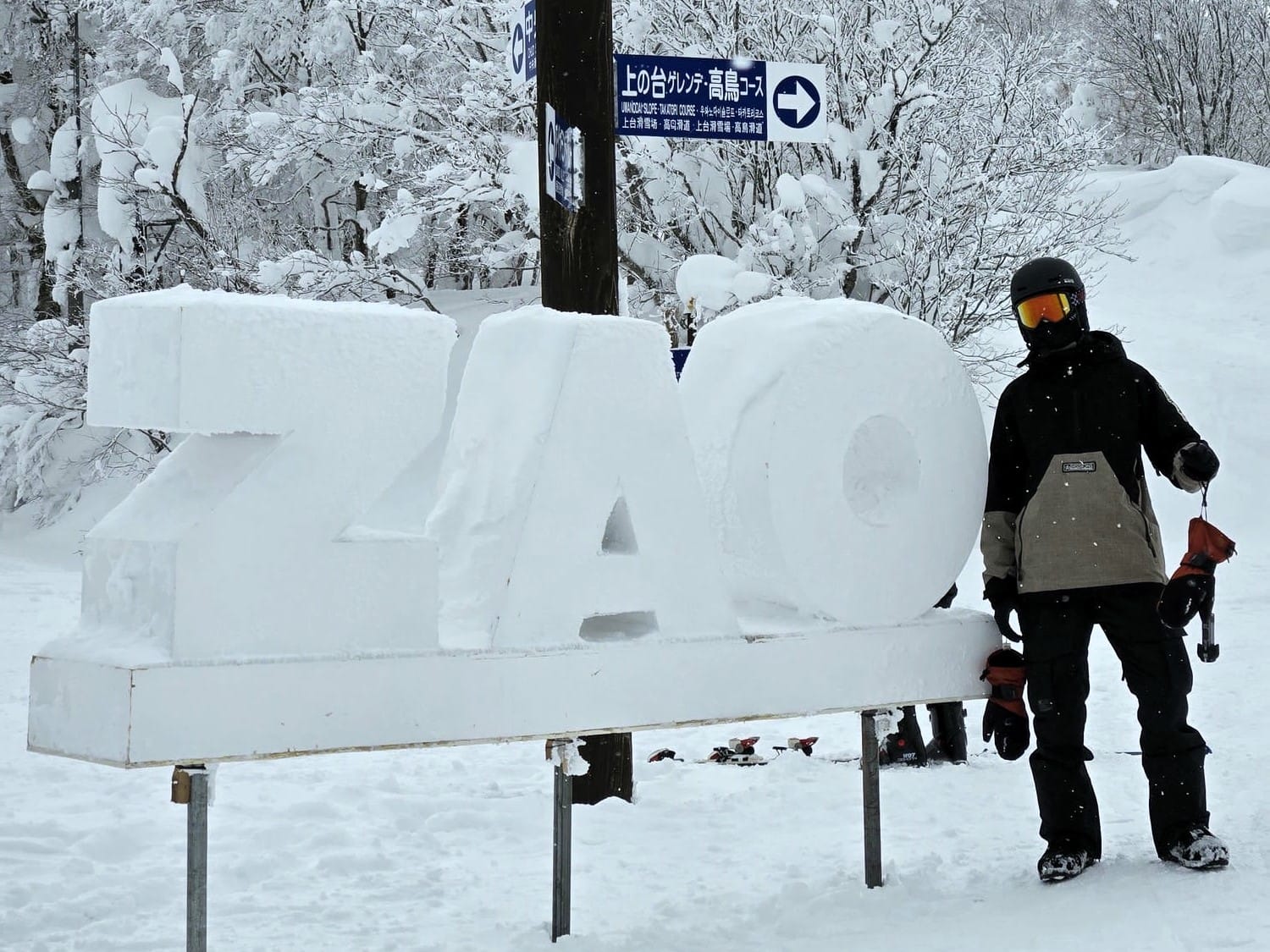
Checking in ZAO
Lift 4 is a small gondola, quite cute. After arriving at the Central Kogen Station, you'll see the ZAO photo spot.
We took photos there—the same spot as the three-generations photo earlier. XD


Lunch: San-Goro Hut
Next, we visited the famous San-Goro Hut for lunch.
Took 33 up, then skied down to Lift 12, where San-Goro Hut is located.


There’s an air gun at the entrance of San-Goro Hut, which is thoughtful for skiers. No wonder it’s called Cafe Restaurant Hotel.
Stepping into San-Goro Hut, I was instantly surrounded by warmth. Not just physically, but emotionally. The wooden decor, the fireplace, lazy chairs, and the large windows with snow views gave it a European-style happiness.


We arrived around 12 PM, and the crowd was just starting to gather. We hurried to queue for food.

It got busier later; if you come late, you might have to wait 1-2 hours.
I ordered hamburger steak curry and pudding, plus a drink.
The service is unique; staff walk around calling out numbers with the food. Very energetic. XD
The hamburger steak curry was stable, and the portion was large—good for replenishing energy after exercise.
(But for me, eating so much after exercise was a bit heavy...)
You can get refills at the open self-service drink bar.
San-Goro Hut doesn't provide water cups like other restaurants, apparently because people were using them for drinks. They even put up a sign. XD
The pudding was amazing, highly recommended. Rich and smooth, with the Zao Central Ropeway logo on it, which added to the atmosphere.


If I have the chance to come to Zao again, I'd love to stay at San-Goro Hut, but you probably have to book super early.
Heading to Torikabuto, Skiing to Zao Onsen Street
After lunch, we took Lift 12 to the Central Ski Area, then split up. Gino went back to Kurohime/Omori to practice, depending on his leg.
I went back to Torikabuto, skied down the Taihei Trail, but turned towards Reimei Ski Area, connected to Antelope Bridge, then to Zao Onsen Station, and took Lift 3 back up to unlock the map.


The lower you go towards Uwanodai and Reimei Ski Area, the terrain is simpler and wider, with fewer connector trails or flat sections.
Although the snow conditions or variety are slightly inferior to the right side (Kurohime, Millionaire, Astoria), the scenery is better, and you can see the city more clearly.


I took a breath when I reached the bottom of Reimei.
I was panting after skiing down. I didn't expect I could do it. Thinking about it, this was my first long-distance exploration + solo skiing since I started.


Then I crossed Antelope Bridge, turned to Nakamori Ski Area, and went to Zao Onsen Station to take the Lift 3 Zao Central Ropeway back up.
Checking the time, it should be the last run. I planned to take the lift up, connect to 17, then take the Snow Monster Trail, and ski back to Kurohime to connect to Astoria and return to the hotel.


Arriving at Torikabuto Station
Lift 3 reached the end, then transferred to 17. However,
Turning from Torikabuto is really... annoying.
The connector to 17 is a super long, flat road, first through the forest, then a large plain. It’s quite a distance.
I was exhausted from unstrapping and walking. Luckily, I reached 17 around 3 PM, connected to the Snow Monster trail, and skied back to the right side's Juhyo Kogen Station.


Snow Monster Trail Second Half
Lift 17 connects back to the second half of the Snow Monster Trail. This part is a large green run, flanked by magnificent snow monsters.
Visibility was slightly poor in the afternoon, but I finally experienced Zao's most famous, beautiful trail.


But beauty comes with a price.
The second half of the Snow Monster trail is a very flat connector. If you want to speed, you need to do it early.
Snowboarding requires the ability to go straight, and you probably won't make it all the way...
There were many people stopping on the road, making it hard to dodge. It was quite painful. XD


Return
Arriving at Juhyo Kogen Station, I felt relieved that the exploration was over, and I had connected all the maps.
So this is how it connects! Very satisfying.
Finally, I skied back to the hotel and did two more runs on the Astoria green run in front of the hotel. This Zao ski trip came to an end.


Dinner
Standard Japanese dinner~ Today's special was beef cutlet, but it wasn't very good—the only bad meal in four days.

Night at Zao Onsen Street
Since it was the last night, I felt it would be a pity not to visit Zao Onsen Street.
Even though it was past 8:30 PM and shops and baths were likely closed, I decided to go for a walk, take photos of the night view, and buy something at Lawson.
I walked down from Astoria Hotel. It’s 1.6 KM, and the part down from Astoria had no streetlights.
Truly, a bit too bold.


I breathed a sigh of relief when I reached the street lights below.
I passed Lift 1 station and got a glimpse of the Snow Monster Illumination (Juhyo Fantasy Corridor).
It’s a special night activity, and you need to book in advance on weekends.
I heard the wind isn't as strong at night and visibility is good?

I breathed a sigh of relief when I reached the street lights below.
I passed Lift 1 station and got a glimpse of the Snow Monster Illumination (Juhyo Fantasy Corridor), although I didn't go up.
It’s a special night activity.


Bought some cola and Yamagata ice cream, then headed back. In this quiet, snowy world, better get back to the warm hotel.

Day 5: Leaving Zao
Waking up, the weather was even better. Unfortunately, I had other plans in Tokyo, so I had to leave Zao first.
Gino wanted to make the most of the season, so he continued skiing and left in the afternoon.


Before leaving, I bought some Zao cookies as souvenirs.
I had booked the hotel shuttle to the Zao bus terminal, and the staff were on time. They dropped me off, and the ski trip came to an end.


Yamagata Station


Finally, I must praise the service at Zao Astoria Hotel. Although located on the left, the planning was good.
The hotel is a bit old, but they are working hard.
I couldn't help but feel a bit sad that all the hotel staff and lift staff were elderly.
Zao isn't a large resort; it’s connected by multiple operators, and the terrain is remote.
Although the resort is great—many fast lifts, varied terrain, good snow, and they are trying hard (official website, information integration, etc.)—I worry about the future. And the right side really had no one.
Summary
Well, this post is long enough. It was mainly for me to record the memories.
See you in the next post.Hope the next one is shorter.